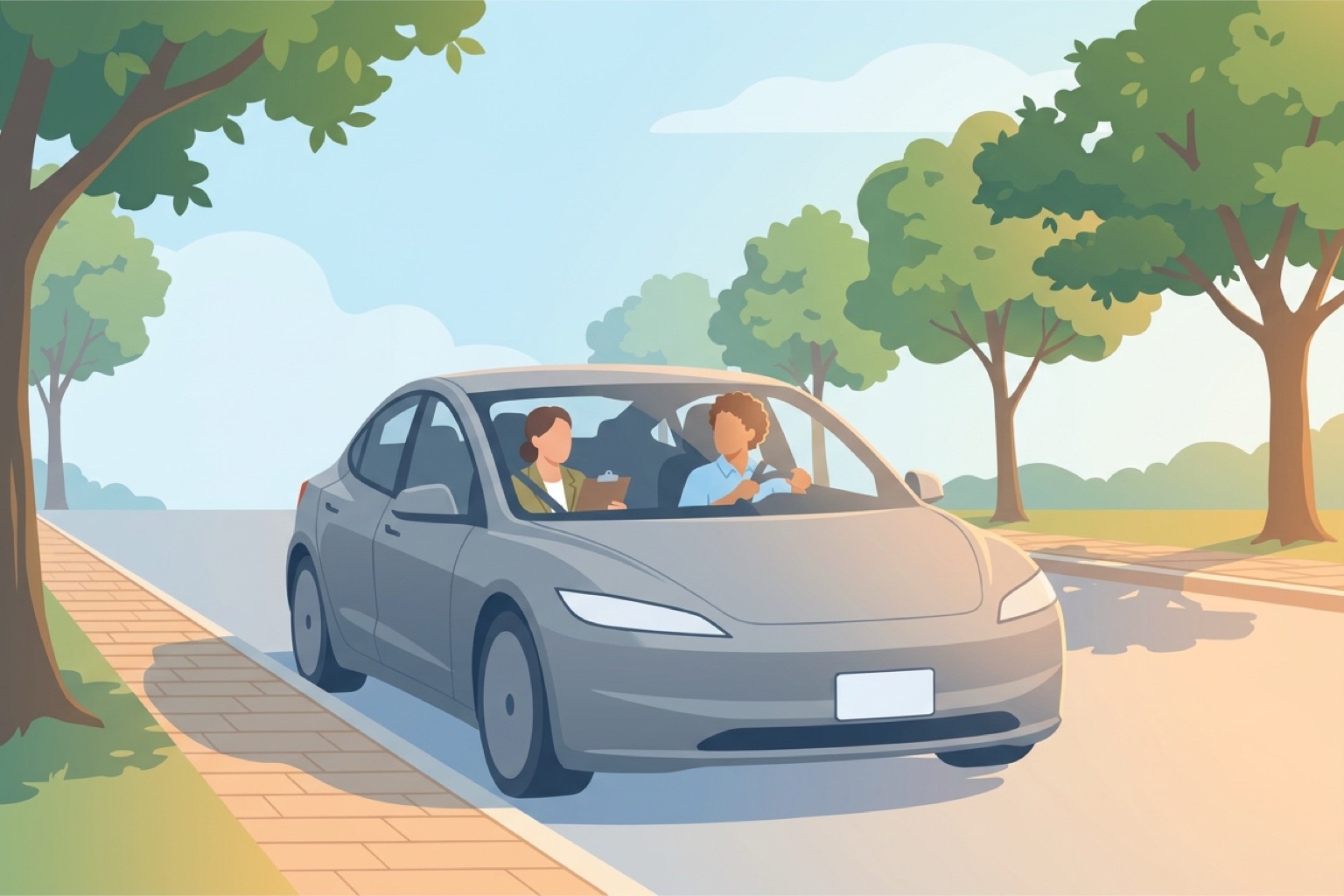
You pass the Texas driving test by driving the way the examiner's score sheet expects: safe, lawful, and predictable — every stop complete, every check visible, every signal early. Most adults who fail on the first try can drive just fine. They fail because they did not know exactly what was being graded, practiced the wrong things, or let nerves turn good habits into rolling stops and silent lane changes. This guide is for adults 18 and older taking the DPS driving (road) skills test for a first Texas license: what the examiner grades, a drill for each maneuver, how to get legal practice time before you have a license, and how to handle the day itself. Paperwork and the car are the other half of passing — that lives on our Texas DPS road test checklist.
The short version: five things that get adults through first time
- Know the graded maneuvers. There is a published list (below). Prepare for that list, not for a vague idea of “driving well.”
- Practice each maneuver until it is boring — in the car you will test in.
- Make your observation visible. The examiner cannot grade a mirror check they did not see. Turn your head.
- Learn the streets around your DPS office at the same time of day as your appointment, so nothing on the route is a surprise (drive it on your adult practice permit with your supervising driver, or ride it as a passenger if you do not have a permit yet).
- Clear the paperwork and the car the night before. Test day should be about driving, not a missing document or a dead brake light.
What the examiner is actually grading
The DPS examiner scores you from a set score sheet, not from a general impression. Per the DPS Form DL-60 (rev. 03-2026), you are graded on maneuvers including backing in a straight line, parallel parking, approaching intersections, turning, stopping in regular traffic, controlling the vehicle, observing traffic, maintaining vehicle position, and using signals. Around the named maneuvers, the examiner expects safe, lawful driving throughout: obeying signs and signals, yielding the right of way, and holding a sensible speed. A genuinely dangerous move — running a stop sign or red light, or anything that makes the examiner intervene — can end the test early. We do not publish scores, deductions, or measurements — DPS sets those and revises its forms over time, and you do not need them to pass.
Maneuver by maneuver: how to practice each one
For each maneuver: what the examiner is watching for, a drill you can run this week, and the slip that most often catches adults.
1. Backing in a straight line
Watching for: slow, straight, and controlled, with you looking over your shoulder through the rear window, not just at a screen or the mirrors. Drill: in an empty lot, pick a painted stripe and reverse along it at walking pace with small corrections only; then repeat along a curb on a quiet street. Adult slip: the backup camera. Use it as a supplement, but the examiner needs to see your head turn.
2. Parallel parking
Watching for: a controlled sequence — signal, pull alongside, reverse while checking around you, straighten, finish close to the curb without hitting it. Drill: mark a space on a quiet street with two trash cans or cones and repeat the same sequence from the same starting setup until you can do it calmly in one attempt. Consistency of setup is the whole trick. Adult slip: rushing, then forcing the car when the angle is wrong. If it is going badly, stop, pull forward, and reset — a calm correction shows control.
3. Approaching intersections
Watching for: scanning left, right, and left again, slowing appropriately, covering the brake, and yielding correctly — whether the intersection has a light, a stop sign, or nothing at all. Drill: plan a route with a four-way stop, a signal, and an uncontrolled residential intersection, and say out loud what controls each one as you approach. Adult slip: carrying speed through an uncontrolled intersection, or freezing when you actually have the right of way.
4. Turning
Watching for: signal before you slow, slow before you turn, and finish in a lane lawfully available in your direction (Transp. Code §545.101) — right turns hugging the right-hand curb, left turns normally ending in the lane nearest the center — without cutting the corner or swinging wide. Drill: loop a block making only right turns, then only left turns, until entry speed and lane discipline are automatic. Adult slip: drifting into the far lane on a turn, a habit common in drivers who learned elsewhere.
5. Stopping in regular traffic
Watching for: a complete stop in the right place — at the clearly marked stop line; where there is no stop line, before entering the crosswalk on the near side; and where there is neither, at the point nearest the intersecting roadway where you can see approaching traffic (Transp. Code §544.010(c)) — with smooth braking, then moving off only when it is safe. Drill: for a week, at every stop sign, stop firmly enough that you feel the car settle, then look both ways before you roll. Adult slip: the rolling stop — experienced drivers do it without noticing, and it is fully visible from the passenger seat.
6. Controlling the vehicle
Watching for: smooth steering, steady speed, and gentle braking, with no jerky inputs. The examiner may also ask you to show where the lights, wipers, defroster, and horn are, and to demonstrate hand signals, before you pull out. Drill: practice in the exact car you will test in and learn its controls until you can find them without looking. Adult slip: borrowing an unfamiliar car for test day.
7. Observing traffic
Watching for: regular mirror checks, a blind-spot check before every lane change and pull-away from the curb, and scanning at intersections — all of it visible. Drill: exaggerate your head movement on every check for two weeks of ordinary driving; before every pull-away: signal, mirror, shoulder. Adult slip: checking with your eyes only — from the passenger seat it looks like no check at all.
8. Maintaining vehicle position
Watching for: staying centered in your lane, keeping a following distance that leaves you room to stop, and choosing the correct lane for where you are going. Drill: on a straight road, pick a reference point for lane center and hold it; behind another car, ease off until you could stop comfortably if it braked. Adult slip: nervous over-slow driving that drifts toward the curb or parked cars. Drive at the limit and with the flow.
9. Using signals
Watching for: a signal for every turn, lane change, pull-away from the curb, and the parallel park — early enough that other drivers can react, and cancelled afterward. Drill: signal before every lane change in your normal driving, even on an empty road, until it is a reflex. Adult slip: signaling as you begin the turn instead of before it, and leaving the signal on afterward.
How adults get practice time legally
The driving test is a skills test, so you need seat time on real roads before you take it. If you do not have a license yet, you have three good options.
- Get the optional adult practice permit. A learner permit is optional for adults 18+; there is no required waiting period (the six-month hold applies only to under-18). You need it to legally practice on public roads, and DPS also requires it before a third-party road test at a driving school. An adult first-time applicant does not get the teen learner license — an adult who wants to practice first gets a regular Texas driver license with a restriction (DPS calls it the “B” restriction). While practicing, you must be accompanied by a licensed driver who is at least 21, holds a license valid for that vehicle, and has at least one year of driving experience, seated next to you (Transp. Code §521.222(d)). Details are in our adult learner permit guide.
- Book a few lessons with a driving school. An instructor is the fastest way to fix a habit you cannot see yourself. On-road lessons are public-road driving, so get the adult practice permit first and ask the school what it requires. Some schools also offer the third-party road test, so you can test in the car and on the roads you practiced on. See our adult driving schools by city.
- Use private property for the parking and backing drills. An empty lot (with permission) is the place for parallel parking and straight-line backing repetitions before you take them onto a street.
Build up in stages: the lot, then quiet residential streets, then the streets around the site where you will test, at the time of day of your appointment.
The night before and the morning of
Each of these has sent an adult home without taking the test. Clear them the evening before.
Use our free Texas DPS document checklist for the identity, residency, and application paperwork, and the road test checklist for test-day specifics. Your Certificate of Completion and your ITAD certificate are two different documents from two different organizations; bring both.
During the test: what calm looks like
- Set up before the examiner gets in: seat, mirrors, seatbelt, a quick scan of the controls.
- Follow directions exactly, and ask if one is unclear. “Did you say the next right?” costs nothing. Guessing does.
- You do not need to narrate, but your checks must be visible — head turns for mirrors and blind spots, a clear left-right-left at intersections.
- Drive at the limit and with the flow. Creeping along reads as poor control, not as safety.
- If you make a mistake, keep driving the way you practiced. One slip rarely ends a test; the panic after it often does.
Third-party testing: same test, different building
Some driver education schools administer the driving test under the DPS Third Party Skills Testing program: the same test and maneuvers, often in the school's car on roads you can practice beforehand, usually with a much shorter wait. DPS lets you test there only once you already hold a valid restricted driver license (the adult practice permit), a current ITAD certificate and, if you are 18–24, your ADE-1317 Certificate of Completion, so your first DPS visit, including the vision test, comes first. After you pass, you return to DPS to be issued your license. Confirm a school's current authorization before booking; our third-party road test guide covers how it works and typical costs.
If you do not pass
It happens to careful drivers. The examiner tells you where you lost marks — that is your practice list — and DPS sets the rules on when and how often you can retest, so check with the office or the DPS scheduler, not a forum. If it comes down to one or two maneuvers, consider one lesson focused on just those before you rebook.
Where the 6-hour course fits (and what it cannot do)
If you are 18 through 24 and applying for your first Texas driver license, Texas requires you to complete an approved driver education course; the Happy Drivers Ed six-hour adult course is a qualifying course. Texas DPS accepts the ADE-1317 Certificate of Completion in lieu of the written (knowledge) test — the highway-sign and traffic-law parts — for certificates less than two years old. That is DPS accepting the certificate, not a waiver we grant. If you are 25 or older, driver education is not required — but if you take the course voluntarily, DPS accepts your certificate in lieu of the written test the same way. The two-year rule is written for applicants under 25, so plan to use your certificate within about two years.
What no course can do is waive the driving test. The vision test is taken at DPS, and the driving (road) skills test is taken at DPS or a DPS-authorized third-party skills-testing site — at any age. Happy Drivers Ed runs the online course and issues your Certificate of Completion; Texas DPS runs ITAD, the tests, and your license; TDLR licenses driver education providers like us (provider #C3476).
Still need the 6-hour adult course? It is online, self-paced, and includes the in-course written exam — finish it before your road-test appointment.
Start your course — $39.95